



|
 |
||||||||||||||||||||||||||||||||||||||||||||||||||
 |
|||||||||||||||||||||||||||||||||||||||||||||||||||
 |
|||||||||||||||||||||||||||||||||||||||||||||||||||








































|
DEVELOPMENT BACK TO BASICS posted 23 December 2013
Every club in the country will be urged to adopt the successful Sheffield model in an effort to increase the number of youngsters taking up cycle speedway.
The Commissions focus for 2014 is not elite racing or international racing. Its not even about racing at all. The Commission needs to focus on grass roots activity, developing and building its existing clubs with new members and getting the base of the sport right said Brown.
To achieve this, the Commission must provide the necessary support to guide, educate and encourage all clubs to build their clubs from the bottom so that every club has a club night with a least 20 riders taking part. Such support must include the recruitment and training of helpers, funding support and promotion and marketing. As the clubs develop they can introduce racing, both locally and regionally, once club night activity is well established explained Ian Brown.
Outlining his vision for the future Brown said the Commission should develop a standard plan which can then be adapted for each club to reflect their current development. The plan, to produce a regular club night or Saturday morning club, will include a progressive list of activities, necessary equipment, fund raising and recruitment of club helpers as well as participants.
The Commission should provide a manual for every club on the pathway to develop a club night suggested Brown. Racing is put on the back burner. Instead activities will be designed to practice key skills in a progressive manner, depending on the age and ability of those taking part.Each session could end with an introduction to racing, against the clock at first, then mini one or two lap races, using a handicap system.
In order for the plan to succeed, it will be necessary to build a stock of bikes, assist clubs to buy a fleet of bikes and provide safety equipment for riders as well kitting out helpers with clothing and necessary equipment such as cones Brown told fellow Commissioners.
Key will be creating a professional approach to encourage growth. Clubs will also need advertising material together with websites and Facebook/Twitterpages to keep riders and parents up to date. Clubs will also need help with grant applications and assistance in fund raising to provide first aid and coaching courses and other volunteer programmes Brown added.
British Cycling is expected to provide further details to clubs in the near future.
However, the report is likely to be at variance with the views of Commission which has openly endorsed its preference for two top divisions - the Elite League and the Premier League with six teams in each.
The report argues that the sport cannot sustain two national leagues at present, author Grange suggesting that there are insufficient quality riders to make up two divisions and corresponding Combination leagues and that expansion to two leagues at present could have a detrimental effect on regional racing. However expansion to two tiers would not be ruled out in the future. In the interim it is suggested that the present Elite League could be expanded from the present six teams to eight in the near future, perhaps as early as 2014.
The report also reflects discussion at the national development conference, led primarily by four-times British champion Lee Aris, about the impact of secondary registrations on regional racing. Its believed the report advocates the introduction of an Elite League riders licence which would obviate the need for secondary registrations in their present format. Its envisaged that secondary registrations would only be applicable to regional racing, administered by the regions themselves.
In order to accommodate those clubs outside the Elite League who would like additional team fixtures, Grange is advocating the introduction of what is called the Club Matching Service. Clubs would enter their requirements on an online database (junior matches, womens events, four-a-sides etc) and these would be married up with other clubs, so providing tailor-made inter-club competitions.
One significant change is the idea of replacing the Combination League with a Development League. After receiving feedback from the conference and clubs, it is widely rumoured that Grange has dropped this proposal from the final report. Instead he is advocating introducing some sort of rider control that would bar the sport's top riders from competing at Combination level.
Proposals to hold an annual Elite League Club Forum has been widely welcomed. It will give clubs the opportunity to comment on and influence the management process although British Cycling has already pointed out that this will be an advisory as opposed to a decision-making forum. It is expected the first forum will take place later in the year, probably in September or October.
The report will challenge some Commissioner's long established views on the future of top tier racing including the suggestion in some quarters that Elite League racing should predominantly take place on Saturday evenings and that a second tier should be introduced regardless, even if it means just four teams contesting the Premier League.
Competitions are always high on conference agendas and this years was no exception.
Ian Brown outlined the Commissions competition plans for 2013, providing supplementary information about some of the national competitions. This years calendar will be more structured with the finals weekend and team final proving a fitting finale to the season. He also hinted that the Commission was in discussions with a third party to promote the indoor championships in December.
For third year running there will be a change in the way riders qualify for the British individual final. After utilising the traditional two semi-finals format with eight riders progressing to the final, last year the Commission surprisingly opted for three qualifying rounds with five or six riders going on to contest Mondays final.
This proved unpopular with many riders, so now administrators have introduced a third qualifying mechanism which will see an, as yet, undisclosed number of riders qualifying on Saturday and the remainder going into Sundays repechage for the final qualifying places.
Some delegates suggested that the under-16, womens and open final should all be staged on the same day, Bank Holiday Monday. Others advocated returning the under-16 final to Monday, reverting the womens final to the body of the weekend.
The ill-fated Womens League will be replaced by a pairs league, similar to a squash league with competitors divided into three capability groups with promotion and relegation. There will be four rounds, one in each region, together with a supporting individual grand prix. There will also be a one-off inter-regional event, each region racing against one another.
CLUB MANAGEMENT TOOL DEMONSTRATED posted 22 January 2013
Before doing so, two short British Cycling videos were shown Why Join a Club? and Go-Ride British Cyclings Development Programme, the latter featuring Neil Howarth extolling the virtues of cycle speedway and the safe environment it offers. There were also interviews with parents.
Developed with the help of existing cycling clubs, the Club Management Tool is free to all affiliated clubs. Through an online dashboard, clubs will have access to a public profile on the British Cycling website, subscription collection, newsletters, free website design and hosting, and an interactive club calendar enabling riders to book onto club activities.
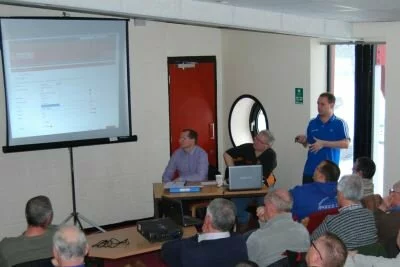
Fella methodically walked through the various options, demonstrating the systems online capabilities. Full instructions and support on how to use the tool is also offered by British Cycling.
For further information click on http://www.britishcycling.org.uk/media_centre/article/clu20121115-British-Cycling-Launches-Online-Management-Tool-for-Clubs-0
75 ACTIVE REFEREES - posted 22 January 2013
Referees coordinator Mike Hack reported that cycle speedway has a 136 registered referees of which 75 are active referees, so on paper at least, it appears that cycle speedway is well served for race officials. However referee abuse is clearly still a problem. Determined to tackle the issue, the Commission is looking to improve rider education around rules, even advocating that a Rule of the Week column could be published in Spokesman, an initiative the editorial team would happily support.
Hack insisted that referees are not card happy. Only three yellow and six red cards were issued in 2012.
Club management had a key role in improving relationship with referees and could play their part by taking more responsibility for rider behavior and accepting referees decisions.
Referees were encouraged to support the Referees conference to be held at the Hilton Hotel, Leicester on Sunday 17 February (contact Paul West at BC headquarters for more details)
MISCELLANY posted 22 January 2013
Several other matters were touched on. In recent years the British Youth and Junior League had benefitted from a £4,000 a year sponsorship deal with Wosskow Brown Solicitors, however that agreement ends this year. In order to maintain a suitable level of prizes, riders would be charged an entry fee for competing in the national rounds.
Ian Brown reported, somewhat vaguely, that the Commission had asked an undisclosed person (widely expected to be former rider Vic Haines), to try to gain sponsorship for the Elite and BYJL.
Despite appalling weather conditions, over 40 delegates attended the national cycle speedway development conference at Alexander Stadium, Birmingham on Sunday.
Representatives discussed a wide range of subjects from the Elite League to secondary registrations, Go-Ride initiatives to website tool kits, from womens racing to referee abuse.
British Cycling Board member Richard Kennedy, standing in for newly appointed Cycle Speedway Commission chairman Tony Barry who is holidaying in America, welcomed delegates before handing over to Ian Brown who conducted most of the business during a positive five hour meeting.
In keeping with the conference format, although there was much encouraging debate, no positive decisions were made. Instead the main conclusions will be drawn together by the Cycle Speedway Commission and discussed further at its meeting on 2 March.
In the next few days, we will be taking a closer look at the issues facing cycle speedway by examining the conference debates more closely, kicking off with the review of top tier racing. Keep clicking spokesman-online. First for cycle speedway.
Editors Note Did you attend yesterdays conference? How do you think it went? Is cycle speedway on the right track? Where do we go from here? Please let us know your views and well share them with other Spokesman readers. MAJOR SHAKE-UP OF TOP TIER RACING PLANNED posted
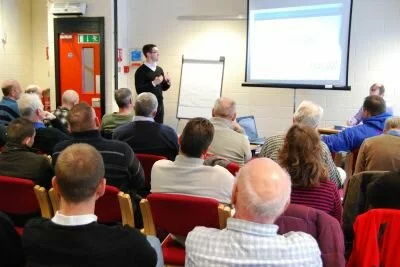
The reports author, Ian Grange, covered a wide spectrum of carefully considered issues, each selectively consulted on prior to finalising the report and making his presentation.
The main conclusions stemming from the comprehensive and well argued report were two fold. Firstly that the sport could not at present support the Commissions vision of two six-team national leagues and secondly that all clubs must be encouraged to recruit riders, and develop their own teams.
The word sustainability was the common thread running through the presentation, Grange returning to it several times. He cited the dangers of importing riders, from both home and abroad, arguing that clubs must develop and nurture its own talent.
Leaning on well researched statistics, Grange felt a two tier national league was not realistic at this stage but with careful planning could be developed in future years, predicting 2017 as the optimum date for a two six-team divisions to be fully operational.
We not have the rider numbers currently to support the proposed Elite and Premier League structure of ten teams or more he told the attentive audience. Only 55 riders raced in six Elite matches or more in 2012. That represents just 7.86 riders per team. Interestingly only 22% of those 55 riders were developed from the Combination league over the period 2010-2012 he added.
Returning to the theme of Elite League stability, Grange used Leicester as an example of what can happen if clubs dont develop their own riders.
As long as I have been involved in the sport, Leicester have always been in the top tier. Its sad to see such a great club riding in regional league racing. That shouldnt be allowed to happen insisted Grange.
Clubs must be encouraged to recruit riders, and develop their own teams. We need a culture change from the current short-sighted win in an instant mentality. This is imperative to ensure we have a sport for future years to come. Nothing can be done to physically stop super teams being built, but we can work to change clubs mentalities towards their development and the way they recruit riders said Grange with true conviction.
Anything we do to change the Elite League must be positive towards regional league racing, not detract from the regional structure.
Not making specific reference to any clubs, Grange felt there was potential to develop a two tier national league over a period of time. Setting out a detailed agenda, it was suggested that an eight team national league would be viable as early as 2014, extending to two leagues of five teams in 2016 and two six team leagues in the following year.
Grange also touched on the concept of Elite weekends and even an Elite Best Pairs event.
Encouraging better fixture scheduling, Grange suggested We could have weekends of Elite League racing planned to support those with the biggest mileage commitment, for example Poole v Ipswich Saturday night, Poole v Sheffield Sunday, Horspath v Sheffield Saturday night, Horspath v Ipswich Sunday. This would help to free up potential weekends that could be utilised for regional league racing he said.
The idea of an Elite League Best Pairs stemmed from the riders explained Grange. We could look to launch event at the start of the 2014 season but it must be supported by all Elite League clubs he added.
Then advocating perhaps the biggest change, Grange launched his plans for revamping the troubled Combination League with the simple question Whats the purpose of the Combination League
What was meant a serious rhetorical question, brought a chuckle from the otherwise silent audience when one delegate quipped A joke! Never could a point be more aptly or succinctly made.
Coming back to the point of sustainability and clubs developing their own talent Grange convincingly argued that the Combination League should be replaced with a Development League. The new league would be restricted to under-18s and women only. No senior riders would be allowed to compete although one veteran rider would be allowed per team to mentor and encourage the other riders.
While encouraging new ideas and initiatives, Grange felt the newly introduced number 9 and 10 provision was a good one but suggested that the 3,2,1 rule should be scrapped as this negates from the ability to utilise the number 9 and 10 he added.
Grange had consulted widely before unveiling his plans. This theme of continued consultation and dialogue was clearly at the forefront of his mind when he suggested setting up an Elite League managers forum, to be chaired by Elite League manager, to discuss issues and ongoing development.
Grange also advocated that the points-based criteria for Elite League entry should be revised.
We need to have a look at the application criteria, and realign it with a real emphasis on club development; recruitment of riders; club structure; to support an increase in participation. Fundamentally Elite League clubs must be sustainable. For the first time clubs will be asked to submit a ten rider squad for the following season so that rider strength in both the first team and development league becomes a priority for the first time. Clubs must have their own coaches. All clubs must also have Go Ride status, with a vision of Club Mark by 2015 he explained
Moving on the topical subject of television coverage It is a must to keep this piece of work going said Grange.
Can we look to work with British Cycling to see them support the project; promote the benefits of doing cycle speedway, joining a safe and fun environment. Maybe advertise the club finder as the Sky programmes close he questioned.
Leaving no stone unturned in his comprehensive review of top tier racing, Grange then moved on to referees.
We must look to increase the number of referees and look to have referees officiating in matches outside of their home region. We need more education for riders around cycle speedway rules.
On marketing and promotion Grange said We must encourage British Cycling to promote all EL fixtures via their Twitter and Facebook accounts. There could be a designated section on BC website for the Elite League with pieces about each club, venue details, rider profiles, club history, details of club nights and Come and Try It nights, that sort of thing. Starting this season we could have pre-match previews and reports produced for BC website and Spokesman and produce official rider stats, averages, number of wins, exclusions etc. Riders love that sort of thing explained Grange.
Finally, after a polished and professional presentation, Grange returned again to sustainability and the importance of what he called the cycle speedway participant development model (player pathway), charting a riders progress from club night fun, through local league and regional racing, the BYJL, the Development League, the Premier and Elite Leagues and ultimately international competition.
Following the presentation, there was a question and answer session with very few dissenting voices. One delegate emphasised that the Combination should be just that, a combination of ages and abilities while another asked where his second string riders, those not good enough for the Elite League, should race.
As a presentation it was a tour de force, full of ideas punctuated with a sprinkling of tact and diplomacy. Without being too gushing it was statesmanlike, even inspirational. Granges commitment and enthusiasm was certainly evident, a quality that seemed to percolate to what can sometimes been seen as a conservative audience. As they trudged to their cars through the ever deepening snow, even the most pessimistic delegate will have left with a warm glow and a contented feeling that better days are ahead.
GO-RIDE BENEFITS EXPLAINED posted 21 January 2013
The first speaker of the day was British Cyclings Rob Mace who enthusiastically outlined the benefits of Go-Ride and Club Mark accreditation. There are now ten Go-Ride and ten Club Mark clubs, representing more than half of all registered cycle speedway clubs. However Mace was keen to encourage more clubs to seek the widely recognised award and outlined the benefits to those clubs who have yet to go down the Go-Ride path.
Mace also extolled the benefits of British Cyclings entry level Go-Race programme and Young Volunteer courses explaining that Go-Race has many benefits for aspiring clubs including Go-Race racing kit, prizes and support from a qualified coach.
The main thrust of the development committee was twofold funding support and coaching. Three clubs, Heckmondwike, Leicester and Sheffield had benefitted from £20,000 of grant investment for rider recruitment initiatives. In a surprise development, Mace also reported that a West Sussex school was exploring the possibility of building a cycle speedway track in the school grounds.
The subject generated a lot of interest from the floor, several clubs recognising the value of Go-Ride accreditation. More details are available on British Cyclings website.
BYJL UNDER MICROSCOPE posted 21 January 2013
One of the most lively debates centered on the future of the British Youth and Junior League including the raison d'etre for the competitions being.
Some delegates considered the season-long competition was purely a development bums-on-bikes competition while others thought the national rounds should be seen as progression into elite competition for young riders, in other words a separate national competition for those riders who have excelled at regional level.
During the debate about whether points should be carried forward from regional rounds, Ian Brown suggested that the national rounds are also a 'development competition'. Some delegates questioned that, countering that if this was the case, it could negate the need for national rounds in favour of continued regional development.
At one stage, the chairman suggested conducting a straw poll to see how members viewed the competition but the moment was lost in the cut and thrust of the debate, which was a pity as the outcome would have been interesting.
ARISS OPINIONS STRIKE A CHORD posted 21 January 2013
One of the most dramatic parts of the conference came when four-times British champion Lee Aris (pictured above) spoke passionately about the harm secondary registrations are doing to the sport.
How can it be right that a rider can use club facilities, train, socialise and enjoy all the benefits of being a club member and then be given a free licence to go and ride for someone else a hundred miles up the road Aris told the conference.
He welcomed the close season trend which has seen more riders move back to the home region and called for the sports administrators to review the secondary registration system.
His fervent opinions clearly resonated with delegates who warmly applauded Ariss strongly-held views.
DISCIPLINE STILL A PROBLEM posted 21 January 2013
The vexed question of cycle speedway discipline was another emotive subject. Several delegates expressed the view that British Cycling officials did not understand the passion of a team-based contact sport. They also argued that some of the disciplinary fines were extortionate and not in keeping with the nature of the offence.
The chairman said that all disciplines have their passions before going on the explain that BC had engaged a team of specialist sports lawyers to advise on best practice. As a result a new disciplinary code had been introduced across all the disciplines. Commissions have no involvement in the process.
We will not be returning to the non-standard process said Richard Kennedy with conviction.
Interestingly it emerged that only three yellow and six red cards had been issued during the season suggesting that some of the disciplinary complaints had resulted from direct reports from clubs or individuals.
While clearly the onus is on clubs and competitors to behave properly there is now implied pressure on clubs and individuals to exercise restraint before submitting disciplinary complaints to BC headquarters.
DEVELOPMENT CONFERENCE EAGERLY AWAITED posted 10 January 2013
Cycle speedways annual Development Conference takes place on Sunday 20th January at the Hospitality Suite, Alexander Stadium, Walsall Road, Perry Barr, Birmingham, B42 2LR starting at 10.30am.
The agenda covers a wide variety of development topics including club, regional and league development, referees and rules.
The conference will be chaired by British Cycling Board member Richard Kennedy and the discussion led by Cycle Speedway Commissioner Ian Brown. The main topics will be presented by Rob Mace and Ian Brown. Ian Grange will also present his eagerly awaited findings following his review of top tier league racing. There will also be the opportunity to hear more about British Cyclings website toolkit.
The conference has attracted a wide spectrum of cycle speedway personnel including some of the biggest names in the game. Besides the full Commission, the list of delegates includes multiple British champions Lee Aris and Colin Wheeler, national coach Tony Bennett, top referees Al Bentley, Ralph Doughty Mike Legge and Colin Simmons, former Commissioners Dave Hunting and John Whiting, and experienced club officials Jamie Goldsmith, Andy Schofield and Colin Sutton.
If you havent booked your place, its not too late.
There is still room for others to come along on the day said conference facilitator Paul West. Just let me know in advance so that I can alter the catering and rooming requirements as appropriate by contacting me on 07507 641267.
Cycle speedways Development Group is making good progress in promoting and growing the sport in the regions.
We caught up with Rob Mace who has been instrumental in driving a number of important developments in recent weeks, including the stabilisation of the Heckmondwike club and an initiative to recruit more local youngsters at Leicester. Heres what Rob told Spokesman
The Commissions development team has been able to assist, provide advice while crossing the ts and dotting the is on certain projects. However, it must be stressed that the clubs and volunteers involved in each project are responsible for the successes so far.
Over £9,000 of funding has been secured from Sport England to be used by Heckmondwike Cycle Speedway and Leicester CSC. This is a lot of money but it will not change the world. What it will do is help more people, be more active more often in cycle speedway. This is really important because what we have seen across the country is that when we create really strong clubs with large levels of participation the sport thrives and things kick on from there. Like an avalanche, one small aspect or impact in the local community quickly snowballs and grows much bigger explained Mace.
The Heckmondwike project actually began back in early 2011. The club has begun delivering weekly sessions for young people, starting with just a few, slowly gaining a few more and now they have the resources for bikes, jerseys, gloves, helmets and most importantly coach education. Three volunteers now have the opportunity to do the Level 2 coaching course. A year and a bit into the project, the club are progressing very well under their own steam and over the next few years activities look set to grow. Already local MPs are taking an interest and facility developments are on the cards demonstrating clearly how things begin to snowball.
The Leicester project was for a smaller amount of money to support the club in recruiting additional novice riders with finance for coaching and a container. Leicester have a track history of developing riders from their community and although further along than Heckmondwike, they have being able to access to financial support from Sport England and provide added impetus to the clubs activities and keep the Leicester ball rolling said Rob.
Some success is beginning to be seen now and the vital objective we shall continue to work towards is getting more people more active more often in cycle speedway, supporting the deployment of more coaches, in more clubs on the ground delivering more accessible coaching and racing activities for young people he added enthusiastically. |
 |

|
|
 |
|